

Occupational Noise Assessment.
Comprehensive workplace noise assessments to protect your employees’ hearing, support compliance with the Control of Noise at Work Regulations 2005, and mitigate legal risks for your business.
Comprehensive workplace noise assessments to protect your employees’ hearing, support compliance with the Control of Noise at Work Regulations 2005, and mitigate legal risks for your business.








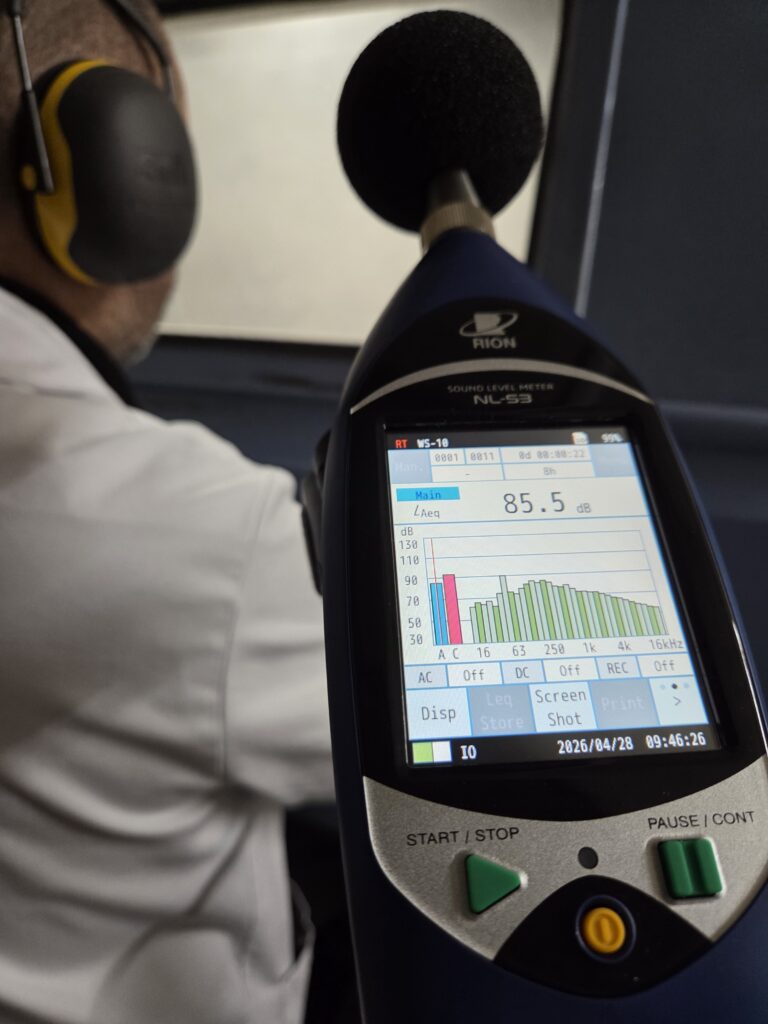
Occupational noise exposure can lead to permanent hearing damage and costly industrial deafness claims. Under the Control of Noise at Work Regulations 2005, employers are legally required to assess noise risks, quantify employee exposure, and implement effective control measures.
We perform comprehensive workplace surveys using personal noise dosemeters and sound level meters. Our pragmatic assessment clearly identifies Hearing Protection Zones, evaluates PPE suitability, and provides actionable recommendations to reduce noise at the source.
A complete, HSE-compliant noise assessment

Measuring noise levels across machinery, work areas, and shift patterns using calibrated sound meters and personal dosimeters.

Calculating individual daily (LEP,d) and weekly noise exposure levels against the lower action values 80 dB(A) / 135 dB(C), upper action values 85 dB(A) / 137 dB(C), and exposure limit values 87 dB(A) / 140 dB(C).

Specifying Hearing Protection Zones, checking PPE attenuation levels, and delivering a practical action plan.
We discuss your operational processes, shift patterns, and machinery to design a targeted noise measurement strategy for your site.
Our acoustic engineers conduct static site monitoring and equip representative workers with personal dosemeters throughout their working shifts.
We calculate daily or weekly personal noise exposure levels, map out high-risk areas, and evaluate whether existing hearing protection is adequate or over-protecting staff.
You receive an easy-to-read, occupational noise assessment report with prioritized recommendations for noise reduction and staff health surveillance.
"Responsive, independent and easy to deal with. They identified the vibration source quickly and gave us a clear path to fix it."

"Forth Noise gave us a planning condition discharge that stood up to scrutiny. Clear advice, tight timescales, and no last-minute surprises."

"Responsive, independent and easy to deal with. They identified the vibration source quickly and gave us a clear path to fix it."

"Forth Noise gave us a planning condition discharge that stood up to scrutiny. Clear advice, tight timescales, and no last-minute surprises."

"They cut through a noise objection that had stalled our application for months. The report was clear, robust, and the planners accepted it without question."

They cut through a noise objection that had stalled our application for months. The report was clear, robust.
"Pragmatic and genuinely expert. They told us what we actually needed rather than over-engineering it, and our workplace noise records are now fully defensible."

Send us the project details and deadline. We’ll come back with a clear, fixed scope and timeline.
The lower action values are 80 dB(A) / 135 dB(C), where employers must provide information and training, and make hearing protection available. The upper action values are 85 dB(A) / 137 dB(C), above which employers must designate Hearing Protection Zones, enforce PPE use, and implement a formal noise reduction program. The exposure limit values are 87 dB(A) / 140 dB(C).
HSE guidelines recommend reassessing workplace noise whenever there are significant changes to equipment, work schedules, or factory layouts, or regularly, and whenever circumstances affecting exposure change; HSE advises not leaving more than about two years without checking whether a review is required to ensure ongoing legal compliance.
No. Under UK legislation, hearing protection should be a last resort. Employers are required to assess noise risks first and attempt to reduce noise exposure through engineering controls or organizational measures before relying solely on PPE.
Usually very little. Our engineers work alongside your staff without interfering with standard production. Personal dosemeters are lightweight, unobtrusive, and worn by employees as they perform their normal daily duties.
