

Noise Modelling & Prediction
Accurate 3D noise mapping and predictive sound calculations for complex developments – helping developers identify acoustic risks, evaluate mitigation options, and support planning applications.
Accurate 3D noise mapping and predictive sound calculations for complex developments – helping developers identify acoustic risks, evaluate mitigation options, and support planning applications.









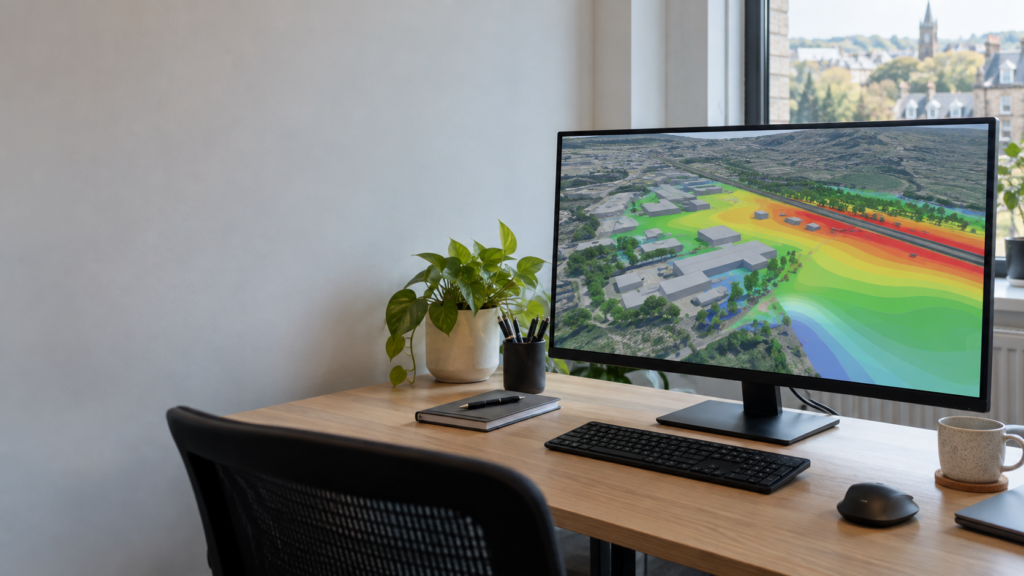
Noise modelling uses industry-standard 3D software to simulate how sound propagates across complex environments, terrain, and building structures. It allows us to predict the acoustic impact of proposed road networks, industrial plant, or major construction projects before ground is even broken.
By visualising sound distribution through clear noise maps, we can test different mitigation strategies — such as acoustic barriers, building layouts, or site orientation — to find the most cost-effective solution for your planning application.

Creation of detailed 3D digital terrain models incorporating site topography, nearby structures, ground absorption, and specific sound sources.

Rigorous sound propagation calculations using recognised calculation methods, including ISO 9613-2, CRTN and CRN to generate high-resolution noise contour maps.

Virtual scenario testing to evaluate barrier heights and façade specifications, presented in a clear, planning-ready technical report.
We gather site plans, 3D CAD/GIS data, topographies, and acoustic source specifications to build an accurate digital representation of the site.
We construct the 3D model in industry-leading acoustic software and calibrate calculations using baseline site measurements where applicable.
We simulate noise distribution and test multiple mitigation options (earth bunds, acoustic fences, layout adjustments) to find the optimal solution.
You receive intuitive colour-coded noise maps and a comprehensive report, along with ongoing technical support for your planning submission.
"Responsive, independent and easy to deal with. They identified the vibration source quickly and gave us a clear path to fix it."

"Responsive, independent and easy to deal with. They identified the vibration source quickly and gave us a clear path to fix it."

"Forth Noise gave us a planning condition discharge that stood up to scrutiny. Clear advice, tight timescales, and no last-minute surprises."

"Forth Noise gave us a planning condition discharge that stood up to scrutiny. Clear advice, tight timescales, and no last-minute surprises."

"They cut through a noise objection that had stalled our application for months. The report was clear, robust, and the planners accepted it without question."

"They cut through a noise objection that had stalled our application for months. The report was clear, robust, and the planners accepted it without question."
They cut through a noise objection that had stalled our application for months. The report was clear, robust.
Send us the project details and deadline. We’ll come back with a clear, fixed scope and timeline.
Physical sound measurements only capture existing noise levels. If your project involves new construction, revised road layouts, or unbuilt industrial plants, noise modelling can be used to predict future sound levels and test mitigation before construction and test mitigation before construction starts.
We use industry-standard computer modelling software adhering to recognised UK and international calculation methods, including ISO 9613-2 (industrial/plant noise), CRTN (Calculation of Road Traffic Noise), and CRN (Calculation of Railway Noise).
The reliability of a noise model depends on the quality of the input data, calculation method and modelling assumptions. By inputting precise 3D terrain data, building geometries, and validated source sound levels, our models provide defensible results suitable for supporting planning and design decisions
.
Yes, significantly. Virtual modelling allows us to optimise the height, position, and specification of noise barriers or building façades. This prevents over-specifying costly acoustic treatments while ensuring compliance with planning limits.
